
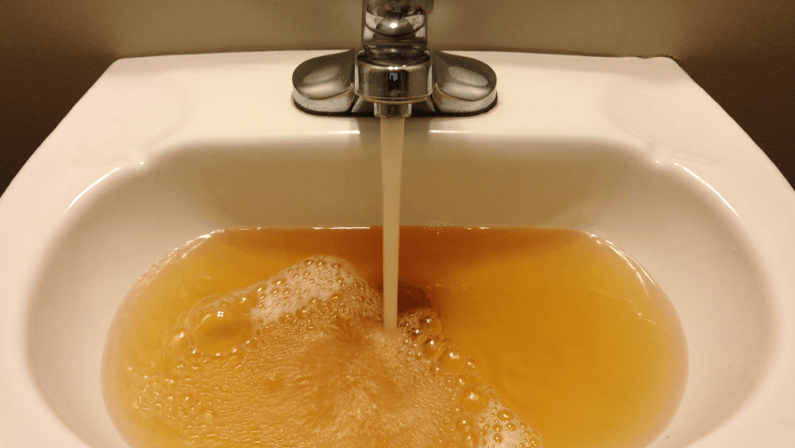
Fort Lee is a neighborhood defined by “Transition.” While many homes have been updated with modern finishes, the “Hydraulic Core” of the older residential districts still dates back to the early and mid-20th century. One of the most persistent technical complaints in these homes is “Rust-Based Discoloration”—the sudden appearance of orange or brown water in your taps. This isn’t just a “Dirty Water” issue; it is a technical diagnostic that reveals specific failures in either your building’s “Arteries” or the “Street Mains” that feed it. At Bkbrownstone, we specialize in sedimentology and water quality forensics. Understanding why your Fort Lee home still shows rust is the only way to achieve a high-performance utility environment. Your tap is a messenger of the grid’s health.
The “Internal Production” vs. “External Intrusion” Conflict
The first step in solving discoloration is identifying the source. If the rust appears only in your “Hot” water, the source is likely your “Water Heater” or an original galvanized iron “Recirculation Loop.” If the rust appears in your “Cold” water only for the first minute of the day, your home is “Producing” its own rust through internal tuberculation of its iron pipes. However, if the rust appears “Suddenly” in all taps after a local fire hydrant flush, it is an “External Intrusion” from the 100-year-old street mains. This is a primary topic in our historic plumbing diagnostics FAQ. Knowing the source is the key to the solution. Don’t replace your boiler if the problem is under the sidewalk.
“Tuberculation” and the Brittle Pipe Legacy
In the older pockets of Fort Lee, original galvanized iron pipes were the standard. These pipes react with the minerals in the water to create “Tuberculation”—jagged “Barnacles” of iron rust that coat the inside of the pipe. When you turn on your tap in the morning, the “Hydraulic Turbulence” knocks these barnacles loose, resulting in the “Orange Pulse” familiar to many historic homeowners. This is the exact same “Internal Rust Cycle” that defines the Brooklyn brownstone experience. We document these material-specific corrosion risks in our restoration blueprints. The only “Permanent Reset” is a move to modern, non-corrosive copper or high-end PEX. Purity requires subtraction. For Brooklyn homeowners facing the same rust cycle, tap water quality testing in Brooklyn can help establish what is present in the water before choosing treatment.
The “Hydrant Flush” Sediment Shock
Fort Lee’s municipal grid is under constant “Scouring” from fire hydrant activity and local construction taps. Every time a hydrant is used, the “Velocity” of the street main increases, stirring up millions of pounds of settled municipal silt and street rust. This “Sediment Plume” is sucked into your home’s 1-inch service line, “Blinding” (clogging) your appliances and shower heads. This is why “Recurring Discoloration” is a feature of life in high-density Jersey (subject to NJ Department of Environmental Protection standards) (subject to standards) neighborhoods. At Bkbrownstone, we emphasize the integration of high-capacity filtration barriers. You must shield your home from the volatility of the city grid. A filter is your home’s first line of defense.
“Dielectric Failure” and Galvanic Corrosion
In many Fort Lee renovations, modern copper was “Tied Into” original iron without a “Dielectric Union” (a specialized plastic insulator). This creates an “Electrolytic Battery” that causes the iron to dissolve at an accelerated rate, injecting a constant stream of rust into your water supply. If you have “Renovated” your bathroom but still see rust, the “Surprise” is that the update itself might be causing the corrosion. At Bkbrownstone, we provide the forensic material audits needed to identify these technical errors. Quality of the joint is the key to the quality of the water. Purity is a matter of material harmony.
Establishing a “Clarity Roadmap” for Fort Lee
To eliminate rust-based discoloration, you must follow a “Clarity Roadmap”: Identify the source, install a “Whole-House Sediment Filter” at the main entry point, and perform a “System Reset” of any legacy galvanized branches. During this process, we recommend a “Velocity Flush” of the street main connection to ensure your new pipes aren’t immediately contaminated by old municipal silt. At Bkbrownstone, we provide the technical specifications for total water quality resets. A home with crystal clear water isn’t a luxury; it’s the result of proactive engineering and defensive maintenance. Know your house, respect the era, and always Know Your Tap.
Conclusion: The Science of Clear Water
Discoloration in a Fort Lee home is an engineering challenge that can be solved with the right data. By recognizing the roles of internal production, external intrusion, tuberculation, and dielectric failure, you can transition your home from “Historic Rust” to “Modern Purity.” Don’t accept orange water as a part of old house living; investigate the infrastructure. Your home is a vertical machine that deserves a clean fuel source. At Bkbrownstone, we are here to provide the audits and the expertise needed to find clarity in the layers of Jersey’s history. A clear glass is the result of a clear protocol. Power and purity are just a technical audit away.